WHO ARE THE BANYAKITARA(Banyoro)
Bunyoro-Kitara has been ruled by three dynasties, The Batembuzi, Bacwezi and Babiito
The Kingdom of Bunyoro-Kitara is believed to have been founded by Hangi of the Bagabu clan under the Batembuzi rule, and the Batembuzi are believed to have come from South Sudan in the Agoro mountains in the current borders of Uganda and South Sudan.
The word Bagabu comes from the word Engabu meaning shield, The Shield, Spear and Crested crane are the main symbols of the Bagabu clan
At its creation, Bunyoro-Kitara was only called Kitara, “Kitara” means the “place of the Twara” or twa la (chief), who would govern itwale – provincial area and the word Bunyoro which come in later means chief or elevated person and was introduced during the Babiito Dynasty rule.
The Bagabu were believed to be hunters according to folklore, customs and traditions, and their court traditions which included Kagingo(illness), Rufu(death), Turo(Sleep) and Njara(Hunger/famine).
he Bagabu clan establishment or rule lasted for about 500 years or 19 generations, from 900 AD to about 1300 AD, and the last ruler of the Bagabu/Batembuzi was Isaza Waraga Muhundwangeye Rugam banabato Nyakikooto, and believed to be the 18th ruler of Bunyoro-Kitara.
Then came the Bacwezi rule from about mid 1350 AD to mid 1400 AD for a period of about 100 years under Omukama Ndahura Kyarubumbi, Mulindwa Nyabweliza Ngango and Wamara Bwigunda respec tively as the only recorded rulers of Bacwezi dynasty in Kitara.
Note: the Bacwezi arrived in Kitara around 1200 AD and are believed to have come from Abyssinia cur rent Ethiopia according to their skin complexions and customs, and Bacwezi Dynasty is different from the Bacwezi Clan.
When the Bacwezi took over Kitara, the court traditions changed from the Bagabu Kagingo(illness), Ru fu(death), turo(Sleep) and Njara(Hunger/famine) to Kintu(He), Kati(she), Kaana(child), Kakama(Milk er), Kairu(servant) and Kahuma(Cattle herder).
The Word Bacwezi comes from kwezi meaning(moon) is its belived to have been acquired when Omuka ma Ndahura was trying to disgusie himself from death of King Bukuku, when Bukuku asked Ndahura his clan name, he simply said “Ndi wo Kwezi”, meaning i belong to the moon clan.
Note: The Bacwezi came to rule Kitara through intermarriage with one of their daughters Nyamata to Omukama Isaza.
he Bacwezi rule collapsed then the Babiito took over, the Babiito have ruled from about 1400 AD to present, a period of about 600 years, The Babiito are called so because of the Biito tree called Omutoma in Runyoro under which thier mother gave birth to them while in Bukidi(Present Northern Uganda)
The Babiito are Bacwezi who had grown up on their maternal side, Omucwezi Kyomya and a Luo lady called Nyatwor gave birth to Isingoma Rukidi Mpuuga, Kato Kimera, Kiiza and Nyarwa.
Isingoma Rukiidi Mpuuga would become the first ruler of the Babiito in Bunyoro-Kitara, Kato Kimera would rule Buganda and Kiiza would ruled Busoga and Nyarwa the eldest would become the Okwir(title for the head of the Babiito Clan).
Having grown up from Bukiidi, the Babiito had learnt the customs of Luo and introduced some of them in Kitara, they introduced the title of Okwir(tough person) who is the head of the Babiito clan, Empaa ko(praise/respect names), and Nyoro which means chief or elevated person and which become syn onyms with Kitara under their rule, hence the Kingdom name Bunyoro-Kitara.
In 1853 the British arrived in Africa to acquire new territories and expand trade, Omukama Kabalega resisted their rule and ended up being exiled for 27 years in the Seychelles and that saw the collapse of the Kingdom, as Punishment for his resistance to colonial rule, part of his Kingdom was handed over to the neighboring Kingdom of Buganda as the collaborators in the British imperial expansion and Tooro Kingdom which Kabaleega was trying to bring back under Bunyoro-Kitara rule.
Between 1900 and 1953 the British made several agreements with the Kingdoms of the Great lakes region leading to the formation of a Country Uganda in 1962.
From 1967 the Kingdoms had no much influence because they were abolished for twenty eight years(28 years) by then President of Uganda, Milton Obote, only to be revived in 1995 by the current Uganda President Yoweri Kaguta Museveni.
Kingdom of Kitara(Batembuzi)
The Kingdom of Kitara was founded by the Bagabu clan around 900 AD
Only two Kitara clans can trace their origins to a single founder by name, the Bagabu clan to Hangi, and the Bayaga clan to Kisehe.
One theory suggests that the Bagabu may have come from the Agoro mountains (border of Uganda and south Sudan) after being displaced by the intrusions of the Dog Nam people moving from the shores of Lake Rudolf, These Nilo Saharan group of people moved south with their goats, seed agriculture and ironworking skills and settled in Kitara.
Another hypothesis is based on linguistic evidence and traditions in northern Uganda, the traditions suggest that they moved from Bahr el Ghazal(sea/river of gazelles)-south Sudan after conflicts around 900 AD and settled in Kitara.
The third hypothesis is that the Bagabu are bantu who came as hunters on canoes from the northwest (Zaire) across lake Onekbonyo-Mwitanzige into Kitara.
Given that their original totem is a crested crane, and crested cranes are typically found in two countries, that is Uganda and Zaire, its possible they came from Zaire, that’s if they didn’t acquire the totem on their arrival into kitara, But most accounts tend to agree that due to their hunting skills, they might have been Nilotics from South Sudan.
The Bagabu trace their origins to a single founder by the name Hangi, a hunter figure. The name of thier clan is derived from the word engabu, meaning “shield” which Hangi, the first ancestor is said to have carried.
Its not known where Hangi came from, Legend say that he was a ruler, that there was no one else in Bunyoro, It was Hangi who gave the names to different things like rivers, villages, mountains and stones.
Legend say that Hangi had four sons, Kagingi(illness), Rufu(death), turo(Sleep) and Njara(Hunger, famine). it is because of Hangi that they are called “Abagabu ba Hangi”, the Bagabu of Hangi, While the corpus of court traditions includes a creation story, only the Bagabu claims links with a “first man.” This clan commemorates Hangi (from the verb “hanga”, to “create”), a hunter who is regarded as the first man to settle in Bunyoro.
The hunter theme of Hangi (with his shield ), the wild bird (crested crane) totem , the acquisition of the “tailless” totem, and the subsequent fragmentation and dispersal of the clan is unique to the Bagabu.
Below as are the known sub clans of the Bagabu
- Basaigi, totem-ente enkira(tailless cow)
- Bakoizi
- Babyasi, totem-ente enkira(tailless cow)
- Abagabo, totem-ente enkira(tailless cow)
- Bakooransi
- Ente/mutima(Buganda)
Note: Totem is regarded as evidence of links between clans, The Babyasi are still found in Congo(Zaire) and have the same totem as the babyasi in Uganda: “People with the same totem were at one time the same clan”
Kingdom of the Bacwezi
The bacwezi dynasty governed Kitara between mid 1300 AD to mid 1400 AD, a period of about 100 years.
The Bacwezi dynasty descend from Isimba, who was son of *Isaza Nyakikooto Rugambanaabato* of the Bagabu clan and Nyamata(milky) of Ruyonga(aka Nyamiyonga) of the Hamites.
Note: The Hamites are believed to have arrived in Kitara around 1200 AD during the reign of Mukonko of kitara and staged in bweera(place of of white people) south of river katonga.
Its reported that the Hamites with thier leader ruyonga(Nyamiyoga) wanted to form one Kingdom with Kitara hence the famous story of Isaza and Nyamiyonga
Isaza was the last Mutembuzi king of Bunyoro-Kitara Kingdom. The Batembuzi ruled the kingdom for an estimated 19 generations.
Isimbwa had seven wives, and one of them produced *Ndahura kyaRubumbi (lit: Ndahura son of a potter)*, who became the first Omukama (king) of Bacwezi dynasty.
bacwezi the clan vs bacwezi the dynasty.
There is a confusion between bacwezi the clan and bacwezi, the dynasty.
The clan is believed to have started when Ndahura was trying to hide his identity from King Bukuku of Kitara which will be interrogated further on.
According to the Isimbiwa genealogy, he married seven women from seven different clans that mothered nine important bacwezi, the other 2 bacwezi being fathered by his children Ndahura and Komya respectively
These are seven (7) children fathered by Isimbwa from 7 different women
- Mugenyi from Nyangoma of the Basingo clan
- Ndahura Kyarumbumbi from Nyinamwiru of the Baranzi clan
- Kango Byonyabwe from Rugonya of the Basambo clans
- Mugarura from Koogere of the Bacwa clan
- Kyomya from Nyabiryo of the ??
- Mulindwa Nyabweliza Ngango from Nyakwahya of the Basiita clan
- Ibona from Waraga of the bacwezi clan
Note: In the above list, bacwezi clan is mentioned as one of the clans that Isimbwa marries from, that means the bacwezi as a clan existed before the bacwezi as a genealogy, and history has it that when Ndahura was being interrogated by Bukuku to identify his clan, he simply said “Nyowe Ndi Wokwezi”(Am of the moon) in fear of being killed by him, So its possible that Ndahura subsequently adopted the bacwezi clan, a clan of the mother of his half brother ibona, from fear of Bukuku.
Its also vividly recorded in the history of Bunyoro-kitara, that King Bukuku had a divination that one of his grandchildren would take over power from him, in fear of this, he kept his only daughter(Nyinamwiru) locked away from the eyes of men, he chopped of her breasts, removed one eye from her and locked her up in one one the enclosures in the palace, when Nyinamwiru got pregnant, Bukuku was shocked, and in his exclamation he stated, “Ndahuura”(will i hear again), hence the baby was named Ndahura from this exclamation.
Bukuku ordered for the killing of baby Ndahura, which did not happen, one of the potters found the child and hid him in the famous caves of Amabere Ga Nyina Mwiru(the breasts of Nyinamwiru)-the alkaline are breast shaped with dripping alkaline and are believed to have been the milk on which baby Ndahura fed on), because of being raised by a potter, he acquired a second name, Kyarumbumbi(son of a potter).
8 Ndahura fathered Wamara from Nyante of the Basengya clan, Wamara would become the last bacwezi ruler
- Kyomya fathered Nyarwa, Nsingoma-Rukidi, Kato-Kimera and Kiiza from Nyatworo of the Bakwonga clan, Kyomya also fathered Kagoro from a maid, Kacubya of the Basaigi clan
Note: History records indicate that Kagoro staged a coup that ended the bacwezi dynasty rule.
Totem/Omuziro of the bacwezi
The bacwezi clan has two totem.
Primary Totem Ente Emira – cow which has drunk salt water.
Secondary Totem: Obusito – colostrum(Milk from a cow and which has just given birth)
The Ente Emira Totem is believed to have been acquired when Omukama Wamara’s cow Bihogo bya Gaju got suffocated on salty water and died, this incident revealed the end of the bacwezi rule became their totem.
The Obusito totem is believed to have been acquired when “Wamara’s blood brother relationship with Kantu caused the milk to change into omutara(red milk)”, – Kantu was kicked by to death by a bull which had just mated, the following day, Cows started producing omutara(red milk), this blood brotherhood [bond of friendship] was loosened, after four days the cows began producing normal milk once more. From then onwards, the Bacwezi decided to avoid the obusito [milk that is from a cow that that has just given birth to calf before 4 days] totem.
Below are the known sub clans of the Bacwezi Clan
- Abatwa
- Abatenzi
- Abasumba
- Abazaazi
- Abembwa(floppy-eared dog totem) – Buganda
- Banvuma(obusito totem/Creeper) – Buganda
- Mbogo(buffalo totem) – Buganda
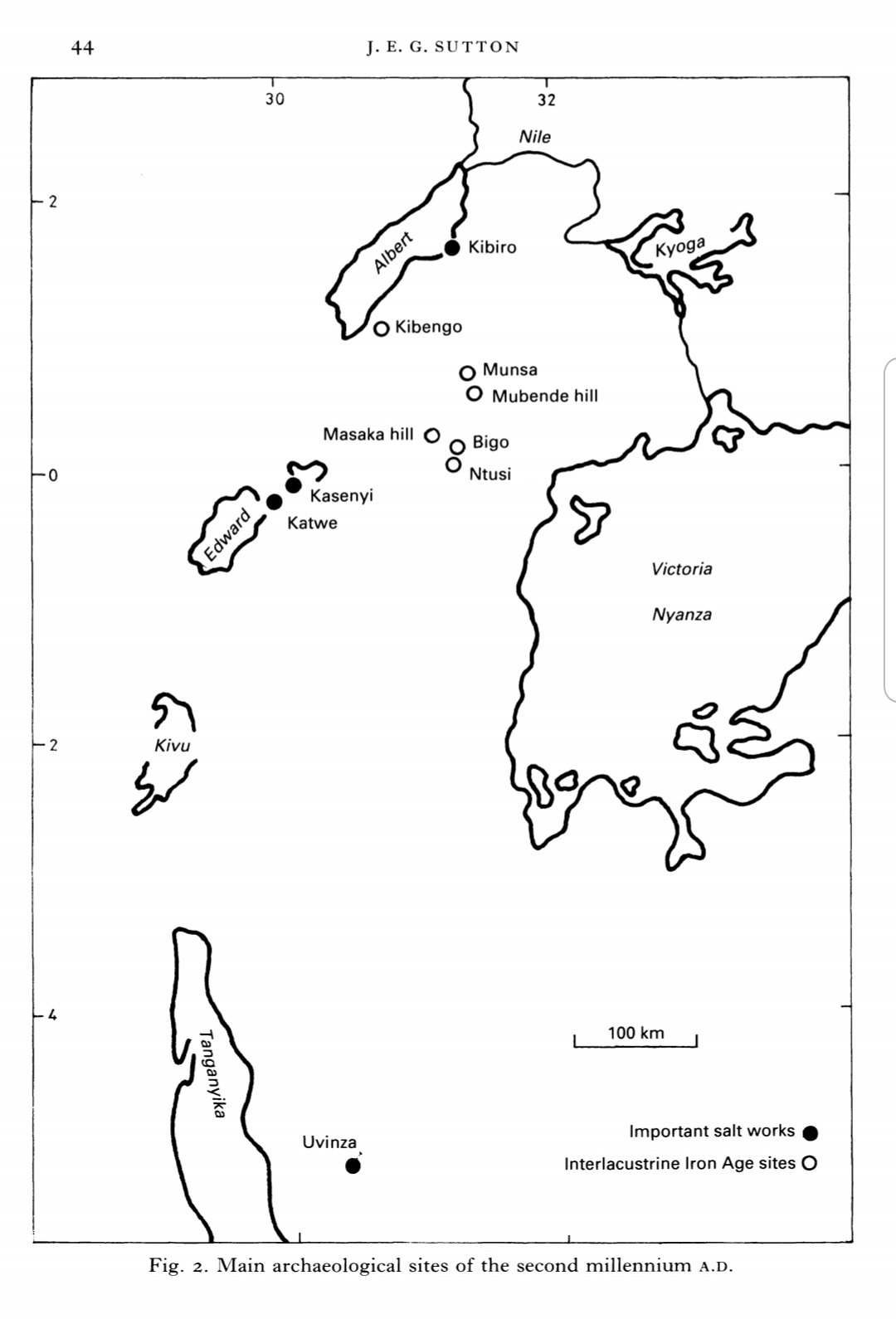
Sites associated with the bacwezi dynasty rule
- Karwata
- Kibengo
- Bijogolo
- Mubende hill, (capital of Omukama Ndahura)
- Masaka hill, situated on the northern bank of R. Katonga (capital of Omukama Wamara)
- Kagogo in Kibooga
- Ntusi
- Bigo
- Bwewemba
- Nyakahuma tree
- Burora hill, located in Buyaga county, near L. Mwitazinge (Mulindwa’s shrine)
- Rusiba hill, (centre for the cult of Kagoro)
- Kasonko
Notable Items/things introduced by the Bacwezi to Bunyoro-Kitara
Political
- Reed Palaces
- Regalia – Branding
- Superior army
- Superior iron making
- Abatimbo, royal drum players
- Moon Ceremonies lasting 9 days
- Reed Fenced royal enclosures
- Cattle and human sacrifices
- Beaded crowns/braces surmounted by tall copper cones
- Ceremonial herding and milk drinking
Economical
- Cattle breeding and Long horned cattle
- Copper spears
- Coffee cultivation, Kibaale forest in Bunyoro
- Back Cloth Manufacturing
- Iron working, earth works and fortifications
Social
- Superior dressing, back cloth, weaved cotton, cotton bandages
- Doctors, Treating smallpox, cesarean section and other diseases
- Cow hides sandals
- Grass thatched houses, cow dung floors, interior decorations (beads ect)
- Entertainment – Mweso(orusoro, Wrestling, Body massage)
- Brotherhood pack(Omukago)
We must say that the notable things introduced by the bacwezi rule where from the hamites whose great grand maternal parents (nyinenkuruza) was Nyamata of ruyonga/Nyamiyonga
Notable bacwezi leaders
- The most outstanding heroes of the period were Ndahura, Kagoro, and Kiro. Ndahura Kyarubimba, Rweshakara Myambi, Rumoona Mahanga, I, his praise names mean “he who thatches himself with thorns”, “attacker of nations,” was the first Cwezi King. When he first took over the kingdom it was in a disturbed and unsettled state. Several of the district (saza) chiefs had revolted against Bukuku and had refused to acknowledge him. Bukuku of the Baranzi clan, had been left in charge of the kingdom after Isaza Nyakikoto Rugambo n’Abato the last Mutembuzi king, had disappeared.
Among the many important things remembered about his reign is the first introduction to Bunyoro of a certain kind of coffee plant known as embyarwa. Today it is found in the forests of Pabidi in Budongo, Mabira in Kyaggwe, Kiijura and Kyabaranga in Toro, and as far south as Kiziba in north-west Tanzania.
Another important introduction was the type of cotton plant known as ewaro. Of the two new plants, coffee became more popular than cotton because cotton had fewer uses than coffee.
Ndahura is also remembered for leading successful campaigns to bring back the empire together from chiefs who had rebelled during the reign of Bukuku.
Ndahura is rembered for ousting Ntege ya koya of Muhwahwa saza(buganda now), he was accusing Ntege of cession tendencies, Ntege belonged to Ffumbe clan and had been appointed during the reign of Isaza, he was thus replaced by Kyomya, Kyomya was made paramount chief of Muhwahwa(Buganda).
Ndahura went on several expeditions and one one of his expeditions in Ihangiro(karagwe), he got defeated and embarrassed by the rule of Ihangiro called bwirebutakya(its recorded that he was made to do manual labor in gardens and eat like a commoner), so when he was freed from this expedition and returned to kitara, he abdicated his throne by telling his people that a defeated king in battle can not rule his people and the leadership went to his son Wamara.
- Kagoro, Kakyomya Mkuba Itera, Matambara Gatoosa Engangule ya Kacubya, was another of the great and brave Cwezi fighters; so much so that many people in Bunyoro still think that he did not die a natural death but flew up to the sky. He is therefore regarded as the god of lightning and thunder, and even today, whenever there is a lightning flash, many Banyoro say: ‘Gentle Araali, the lightning that strikes, your accidents are frequent.’ If someone is struck by the lightning and survives, people say that the Mucwezi god has had a quarrel with him.
- The third hero among the Bacwezi was Kiro Muhimba, who showed his powers during his father Ndahura’s reign. He was delegated to fight and subdue the rebellious people who lived to the north of the country. From there he continued to Bulega and went right round till he met with his father’s army towards the Toro side.
How/why the bacwezi lost power: Coup vs Prophecy
Some history books write that it’s Kagoro who staged a coup to end the bacwezi rule, yet another story points to divination
Coup
Kagoro was among the several sons of Kyomya who was bore by a maid called kacubya, and was a military commander appointed by Omukama Wamara.
Kitara faced lot of famine, followed by cattle diseases that lead to a great deal of dissatisfaction among the people of Kitara of the bacwezi.
Kagoro, Wamara’s military commander, seized the opportunity to stage a coup against the Bacwezi, who were mercilessly massacred and their bodies thrown into water. The Bachwezi aristocracy, was thus annihilated or, as tradition puts it, ‘disappeared’.
The coup marked the end of the Bacwezi Empire, but since kagoro was a half brother to Rukidi Mpuuga and his other brothers, we can assume the coup could have been the possible end of the bacwezi rule because Rukidi Mpuuga takes over governorship there after.
Prophecy
According to other court traditions, the last king of the bacwezi, One of Wamara cattle got suffocated on salty water and died.
When the bull was slaughtered, they found that it did not have intestines, Wamara called on his diviners who failed to interpret the puzzle, a one diviner called Nyakoka from Bukidi (present northern Uganda) offered to solve the mystery.
Nyakoka cut open the legs and head of the animal and there the missing intestines were found. Then a large black smut from the fire settled on them, it could not be removed.
Nyakoka divined that the absence of the intestines from their natural place signified that the country would be left without rulers, because the rule of the Bacwezi had ended.
The intestines’ presence in the animal’s legs and head meant that the Bacwezi would load up their belongings and would travel far away; while the presence of the intestines in the head meant that the Bacwezi would continue to rule over men through spirit mediums (Mbandwa cults) and the *black smut meant that black men from a distant land* where going to take over the governorship of kitara.
Why the bacwezi were/are worshipped?
It has to be noted that the bacwezi were not worshiped during thier rule, but when they left, they began to be worshipped, this is mainly because they had introduced divination(kubandwa) and sacrifices which continued when they left.
The worship part was partly introduced by the new babiito rulers as a way of commemorating and giving respect to their predecessors, The babiito recognized Wamara as thier guardian, this they did to cement their political and social positions in Kitara, From that time (15th Century), the “Wamara” cult acquired the largest number of followers.
In Bunyoro kitara kingdom there is saying of “abacwezi ikumi namwenda abaramibwa* literally, there are nineteen bacwezi leaders worshipped.
List of the these 19 Bachwezi
- Ndahura Atwooki – The god of epidemics.
- Wamara Abooki ruled Bwera now called Budu and Nkole – The god of plenty.
- Kiro Muhimba ruled Bugahya, Bugungu and Chope
- Kyomya Amooti ruled Muhwahwa(Buganda)
- Ibona wa Waraga ruled Kyaka(Kitara)
- Mulindwa Abwooli ruled Buleega & Buyaga- The goddess who protected the royal clan.
- Rubanga ruled Buruli – God of health.
- Mugasa Ibebe ruled Sese Islands
- Kanyabugoma ruled Bugoma
- Kahuka ruled Tooro and Busogora
- Mugarra Karundi Adyeri ruled Bunyara
- Mugenyi ruled Mwenge
- Kagoro Araali ruled Bwiru
- Rukoke Nyakalika
- Kaikara Adyeri was priestesses. Kaikara has a shrine at Semwema Cave – Goddess of the harvest.
- Nyabuzaana was priestesses
- Kagole was priestesses
- Mugizi was priestesses – God of the body of water called Lake Mwitanzige.
- Njunaki was priestesses. Prominent female Mucwezi military commander.
The Kingdom of Bunyoro(Babiito)
The babiito clan are the current leaders of Bunyoro-Kitara, having ruled from around 1400 AD to Present with 27 Kings and counting.
We have to note that the Babiito are bacwezi, they only took up a different name because of where they were born.
Isingoma Mpuuga Rukidi is the founder of Babiito rule in Bunyoro-Kitara after the bacwezi left kitara.
Isingoma Mpuuga Rukidi was the great grandchild of Isaza Nyakikooto, the last Batembuzi King.
When Omukama Isaza was subdued by Nyamiyonga(god of underworld) but probably Ruyonga of the bacwezi(Note: the bacwezi had arrived in Kitara around 1200 AD during the reign of Mukonko of Kitara and staged in Bweera), the encounter lead to the birth of Isimbwa by Nyamiyonga’s daughter Nyamata(milky).
Isimbwa grew up in the underworld and Nyamiyonga had given him one of his women called Nyabiryo, the encounter lead to the birth of Kyomya.
Kyomya was a mucwezi as is the main genealogy to the Babiito ancestry, Kyomya met Nyatworo(lady of the sisal) and had four children, Twins, Isingoma Rukidi Mpuuga and Kato Kimera, Kiiza followed the twins and Nyarwa was the first born
We have to note that during the reign of the bacwezi, omukama Ndahura replaced the governorship of Muhwahwa(Buganda) with Kyomya, replacing Ntege ya Koya.
Isingoma Mpuuga went on to become the first Bito ruler of Kitara, Kato Kimera went on to govern Buganda called Muhwahwa then, Kiiza to Busoga where he took up the name Nyaika, and Nyarwa become Okwir(head of the babito clan).
Why are they called Babiito
When Nyatworo(lady of white sisal) a Mukwonga by clan became pregnant by omucwezi Kyomya, her father, Labongo build her a hut inside his own compound under a biito tree(omutoma in runyoro) and ficus natalensis in English. When the children were born the Bakidi people nicknamed them “the children of the biito tree” and, when inquiring about them, they would say, “How are the children of the biito tree?” From this that time onwards they got stuck with the name it eventually become the name of thier clan.
They also assumed the totem of thier mothers clan which is a Bushback(engabi) which become the main totem of all the Babiito. In Buganda the babiito kings perpetuated this custom by adopting the clan of thier mothers, But the Babiito of Bunyoro, however consequently adopted also the clan of thier forefathers-the bacwezi, and this they observe the obusito totem.
The Babiito also have amalegyo(areas of a swamp where one can easily sink), this totem is believed to have been acquired to conserve biodiversity of non plant and non animal beings.
What the Babiito Introduced in Bunyoro-Kitara
When the Babiito took over Kitara from the bacwezi, like any new administration, they introduced a few changes
- When they moved into Kitara, they found two class systems, Bahuma and Bairu which were introduced by during the bacwezi rule, they introduced a third class system called “banyoro” meaning “chief or elevated men” if one was appointed to govern an area he was referred to as a Munyoro. These Banyoro were sent to govern some areas of Muhwahwa(Buganda). So the Baganda would say “Batuletede Omunyoro” meaning they have brought us a Munyoro hence the name become synonym with Bakitara People and the Kingdom has become to be Known as Bunyoro-Kitara after several generations of using the word Bunyoro and the people hence become banyoro but still banyakitara is used.
- The Chief/head of Babiito Clan is/was given a title of Okwir which is Luo word to mean a tough person.
- They introduced throne names for Kings, like Olimi, Winyi, Cwa, Kyebambe etc, these names are given to Kings depending on how he comes to power or govern during thier reign.
Here is the list of the throne names and their meanings.
- Cwa – means, cut or break, this title was given to a brutal King.
- Ocaki – means, to begin with or the first one, Only the 2nd Babiito King has this title
- Oyo – means, path.
- Winyi – means, listen.
- Olimi – means to receive, its a title given to someone treated with high value, (lim) also means wealth.
- Nyaika – means, spread/multiply
- Nyabongo – come from Dabongo meaning pure/strong like iron
- Kyembambe – A King who usurper his another for a throne was given this title
- Duhaga – means, he will grow strong/taller
- Another important thing they introduced were the empaako or praise names
Empaako is a praise or respect name introduced by the Babiito ruling class in the late 14th Century.
Empako comes from Luo root word “Pako” meaning Praises. It was a yearly cultural harvest ceremony done in the Capital Hoima and attended by all Chiefs of the empire and commoners.
There are twelve pako’s and among the twelve, one is strictly reserved for Omukama and that Okaali, Okaali pronounced as “oo-KAA-li” comes from “kal” meaning Royalty
The other pako’s they introduced are, Atwooki, Ateenyi, Apuuli, Amooti, Akiiki, Adyeeri, Acaali, Abbala, Abbooki, Araali and Abwooli
Sub clans of the babiito
- Abacaaki
- Abangamwoyo
- Abacwa
The Babiito have ruled Bunyoro-Kitara for a very long and among the notable Babiito Kings are:
- Omukama Winyi I Rubembeka Ntara (4th Bito king to rule over Bunyoro-Kitara), He was very brave and it was during his reign that the Baganda first started clashing with the Banyoro, he fought and defeated and killed Kabaka Kayima of Buganda (regarded as 7th Kabaka of Buganda) during the battle for Bwiru (Buddu) present day Masaka. Winyi I’s palace was situated Bwiru near Kitovu in Present day Masaka, the resting grounds of Winyi I are in Kiburara, Isingo/Rugonjo.
- Omukama Olimi Rwitamahanga(Destroyer of Nations), of Kilimbi, was the fifth(5th) Bito king to rule over Bunyoro. In one of the great battle between Olimi and Nakibinge,(regarded as 8th Kabaka) of Buganda, during this battle, Nakibinge was killed with his commander Kibuuka Kyobe Omumbaale during the battle at Mulago.
A number of other neighboring countries also tried to attack Bunyoro but Olimi led his armies and fought them. He even went as far as Ankole, then known as Kaarokarungi (beautiful village or place). It was from this particular campaign of his that his praise name, Rwitamahanga (lit: ‘Destroyer of Nations’ originated)
- Omukama Nyabongo 1 Rulema, Kyambukya Nkaito, was the sixth Bito king and is regarded as a hero because he fought hard to recover parts of Bunyoro which were in revolt. He subdued parts of Ganyi/Madi and brought them back under Bunyoro rule.
While on the way to the north, to fight the battle which later became known as Kyeteme, Nyabongo’s son, Kabakangara, a very brave prince, was drowned as they were crossing the lake. Because Nyabongo crossed the lake and many rivers on his way to battle, his praise name became ‘Kyambukya Nkaito’, ‘He who crosses the river in his shoes’.
- Omukama Cwa I, Ente-Nkore, Rumooma Mahanga, Mbogo Etahurra Bigwara, was the tenth Bito King. His praise names mean, Cwa(true cutter), “Capturer of Ankole cows”, ‘He who crushes nations’ or ‘conqueror of nations’, ‘he who is like a buffalo which will not be intimidated by the sound of the hunter’s horn.’ He was also very brave, and his exploits were mainly carried out in the south of the country. He was very fond of cattle and captured many herds from Ankole.
He met with the Ankole King Ntale I Kiitabanyoro (the ‘killer of Banyoro’), and they fought bitterly. He spent most of the time in Ankole, and when later on he heard that there were more and better cows in Rwanda, he set out to capture some more. He never came back. He met his death there and his tomb is said to be there still.
Omukama Olimi III had also the following praise names: Isansa, Gabigogo Gabohwa Nkya, Birali bya Mpanja, Mikundi ya Nyaraki, Omukwata Galemiire
- Omukama Duhaga I Maherre ga Isansa, Matama Ncwera, Engundu y’ekisiiha(Not easily advisable), was the seventeenth Bito king. He is among those remembered for fighting hard to preserve his country. His biggest battle was the one he fought with Karaiga, king of Ankole. It later became known as the Battle of Kihonoka. During this fighting he captured the Ankole royal drum ‘Bagyendanwa’.
- Omukama Cwa II Kabalega, ascended the throne in 1869 at the age of 16 as the 23rd Omukama from the Babiito Dynasty following the death of his father Omukama Kyebambe IV Kamurasi at Kiryandongo, his names mean Cwa(true cutter), Kabalega(child of baleega).
He chose the throne name Cwa II after Omukama Cwa 1 Ente-Nkore Rumoma-Mahanga whose stories inspired him as a child. Omukama Kabalega also had several praise names which included Ruhiigwa(he who can’t be stopped like very heavy rainfall), Kitule Kinobere Abeemi(he who hates rebels), Rukolimbo Nyantalibwa Mugobe.
The Langi used to refer to him as *”Nyangatunu” meaning the king of kings.
Kabaleega his highly remembered as Bunyoro, Uganda and African hero for resisting British colonial rule, a fierce battle and campaign that lasted for 9 years that led to his capture and exile in Seychelles for 27 years and which eventually led to ruins of Bunyoro-Kitara from a state to a tribe.
Current Territory and Location
Located in Mid-Western Uganda covering the present day districts of Hoima, Masindi, Kibaale, Buliisa , Kiryandongo, Kikuube, Kagadi, Kakumiro, Kyankawanzi, Mubende, Nakasongora, Nakaseke, Kiboga, Kayunga today referred to as “The Oil Land” due to the discovery of the Oil and Gas resource in the area, Banyoro people are soft spoken, down to earth, honest, hardworking and loyal in nature.
Banyoro people are quite welcoming and always eager to help. Banyoro work in unison incorporating other tribes and are quite cooperative in nature, Banyoro boast of adorable medium and tall beautiful light skinned and black beauty complexion girls and women who are well disciplined.
Beauty lies in the hands of the beholder-an old adage goes. In Bunyoro people not only celebrate striking beauty of the face but are blessed with a comprehensive beauty of the face, soul and heart, pleased to host the most intelligent exquisitely down to earth women in Uganda. Banyoro men are by looks muscular medium and tall and will always put family development as a priority.
Bunyoro was an Empire-Kitara Empire far much beyond a nation with vast borders up to Rwanda, Wanga in Kenya, the entire northern Tanzania and entire eastern Democratic Republic of Congo (DRC).
This describes the Runyoro dialects called Runyambo which is spoken in Bukoba and Karagwe in Tanzania and Ruleega dialect spoken in Eastern Democratic Republic of Congo, the Luhya of Kenya can easily be grasped and understood by a Munyoro, all the aforementioned were vast parts of the Kitara Empire.
The Banyoro people speak Runyoro language. It entails various dialects including but not limited to the following; Rugahya, Rugungu, Rucope, Rutiaba, Rukobya, Rugangaizi, Runyakibiro, Rusindi, Runyamwenge, etc some dialects like Rugangaizi emerged as a result of invasion of Bunyoro by other Kingdoms which is a mixture of Ruganda and Runyoro, millet is Banyoro’s stable food.
Banyoro have a unique and exciting cultural base notably Empaako and Empango. Regarding the Empaako, Banyoro bestow sweet praise names to their children called Empaako eg Amooti, Adyeeri, Akiiki etc Addressing a person by his or her Empaako name is a positive affirmation of social ties. It can be used as a greeting or a declaration of affection, respect, honour or love. Use of Empaako can diffuse tension or anger and sends a strong message about social identity and unity, peace and reconciliation.
Empaako is given at a naming ceremony performed in the home and presided over by the clan head. The paternal aunts receive the baby and examine its features. Any resemblance to existing relatives forms the basis of the choice of name. The clan head then declares the name to the child.
Empango is the first ritual the Omukama (King) performs as he is crowned. The reigning King of Bunyoro Kitara Kingdom-His Royal Majesty Rukirabasaija Agutamba Omukama Dr.Solomon Gafabusa Iguru 1, first performed this ritual on the 11th June 1994 thus it has been an annual remarkable day up to date.
Empango celebration is always punctuated by a series of activities which include among others (a) “Omujaato event” which entails bull roasting and various companies promote their brands throughout the night, (b) Sounding of the Royal Drum by His Majesty at 3:00 am on the eve of the anniversary, (c) then comes the main event on the 11th date of June which is graced by cultural dances from the Omukama’s subjects this all climaxes into the Grand Empango Dance which is opened by His Majesty by re-sounding the Royal drum at Nyamyaro at exactly 3:00pm and this continues until dawn.
In Bunyoro marriage is a sweet and highly respected institution. Unlike other cultures which grabs the “bride to be” on the way or at the well, in Bunyoro a girl of marriage age is respected she comes with bride price tag, dowry etc and a sumptuous ceremony. This creates mutual respect in the community and it promotes dignity amongst the women and men of Bunyoro
During harvest time families will exchange gifts inform of crops animals eg omuherya,enkoole, empaande,enkuuku etc. By so doing communities live in peace and harmony.
Bumper harvests are always attained in the last season of the year in December and many songs are heard across villages where local brew Etonto is brewed songs like “Ebigambo binsemerire nyalyana eeeh yiii nkolenta x2. Mundeke mbigambe, Ebigambo binsemerire nyalyana eeeh yiii nkolenta x2” are heard as village folks celebrate the dry season “ekyanda”.
*The various dialects in Bunyoro-Kitara*
- Rugahya (Bugahya/Hoima),
- Rusindi (Masindi),
- Ruruuli/Runyara (Buruuli/Nakasongola/Kayunga/Buleemezi),
- Ruchope (Kiryandongo)
- Rugungu-Rutiaba (Buliisa),
- Rutooro (Tooro/butuku/Busongora/Banyabindi/Batagwenda)
- Rugangaizi (Buyaga,Bugangaizi, Mubende, Kibogo, Kyankwanzi),
- Runyamwenge (Kyenjojo)
- Runyambo (Buloba and Karagwe)
- Ruleega (Baleega)
- Runyakibiro-Rukobya (shores of Lake Mwitanzige/Albert), etc.
Note: the Original Inhabitants who don’t have any connection to migration in the great lakes region are
The IK
The Tepeth and the
The Abatwa
Current Territory and Location
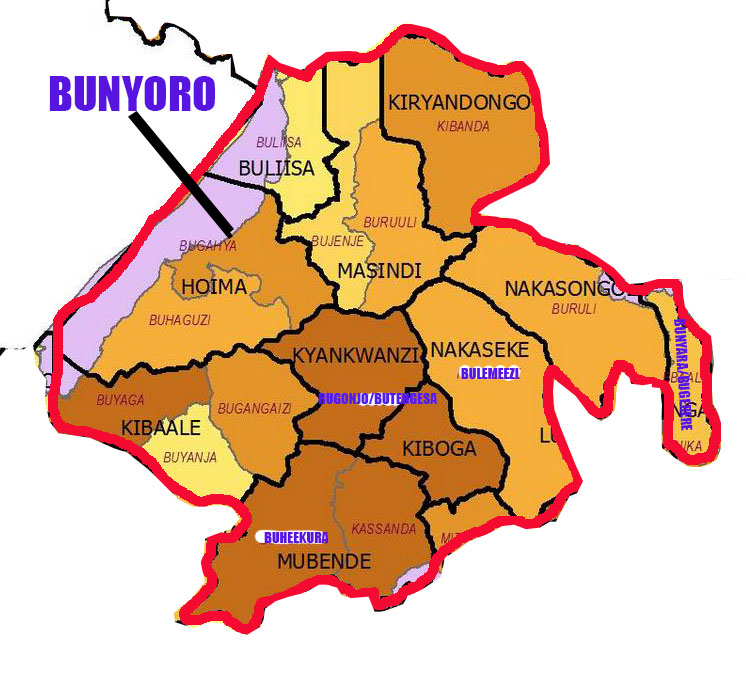
Located in Mid-Western Uganda covering the present day districts of Hoima, Masindi, Kibaale, Buliisa , Kiryandongo, Kikuube, Kagadi, Kakumiro, Kyankawanzi, Mubende, Nakasongora, Nakaseke, Kiboga, Kayunga today referred to as “The Oil Land” due to the discovery of the Oil and Gas resource in the area, Banyoro people are soft spoken, down to earth, honest, hardworking and loyal in nature.
Banyoro people are quite welcoming and always eager to help. Banyoro work in unison incorporating other tribes and are quite cooperative in nature, Banyoro boast of adorable medium and tall beautiful light skinned and black beauty complexion girls and women who are well disciplined.
Beauty lies in the hands of the beholder-an old adage goes. In Bunyoro people not only celebrate striking beauty of the face but are blessed with a comprehensive beauty of the face, soul and heart, pleased to host the most intelligent exquisitely down to earth women in Uganda. Banyoro men are by looks muscular medium and tall and will always put family development as a priority.
Bunyoro was an Empire-Kitara Empire far much beyond a nation with vast borders up to Rwanda, Wanga in Kenya, the entire northern Tanzania and entire eastern Democratic Republic of Congo (DRC).
This describes the Runyoro dialects called Runyambo which is spoken in Bukoba and Karagwe in Tanzania and Ruleega dialect spoken in Eastern Democratic Republic of Congo, the Luhya of Kenya can easily be grasped and understood by a Munyoro, all the aforementioned were vast parts of the Kitara Empire.
The Banyoro people speak Runyoro language. It entails various dialects including but not limited to the following; Rugahya, Rugungu, Rucope, Rutiaba, Rukobya, Rugangaizi, Runyakibiro, Rusindi, Runyamwenge, etc some dialects like Rugangaizi emerged as a result of invasion of Bunyoro by other Kingdoms which is a mixture of Ruganda and Runyoro, millet is Banyoro’s stable food.
Banyoro have a unique and exciting cultural base notably Empaako and Empango. Regarding the Empaako, Banyoro bestow sweet praise names to their children called Empaako eg Amooti, Adyeeri, Akiiki etc Addressing a person by his or her Empaako name is a positive affirmation of social ties. It can be used as a greeting or a declaration of affection, respect, honour or love. Use of Empaako can diffuse tension or anger and sends a strong message about social identity and unity, peace and reconciliation.
Empaako is given at a naming ceremony performed in the home and presided over by the clan head. The paternal aunts receive the baby and examine its features. Any resemblance to existing relatives forms the basis of the choice of name. The clan head then declares the name to the child.
Empango is the first ritual the Omukama (King) performs as he is crowned. The reigning King of Bunyoro Kitara Kingdom-His Royal Majesty Rukirabasaija Agutamba Omukama Dr.Solomon Gafabusa Iguru 1, first performed this ritual on the 11th June 1994 thus it has been an annual remarkable day up to date.
Empango celebration is always punctuated by a series of activities which include among others (a) “Omujaato event” which entails bull roasting and various companies promote their brands throughout the night, (b) Sounding of the Royal Drum by His Majesty at 3:00 am on the eve of the anniversary, (c) then comes the main event on the 11th date of June which is graced by cultural dances from the Omukama’s subjects this all climaxes into the Grand Empango Dance which is opened by His Majesty by re-sounding the Royal drum at Nyamyaro at exactly 3:00pm and this continues until dawn.
In Bunyoro marriage is a sweet and highly respected institution. Unlike other cultures which grabs the “bride to be” on the way or at the well, in Bunyoro a girl of marriage age is respected she comes with bride price tag, dowry etc and a sumptuous ceremony. This creates mutual respect in the community and it promotes dignity amongst the women and men of Bunyoro
During harvest time families will exchange gifts inform of crops animals eg omuherya,enkoole, empaande,enkuuku etc. By so doing communities live in peace and harmony.
Bumper harvests are always attained in the last season of the year in December and many songs are heard across villages where local brew Etonto is brewed songs like “Ebigambo binsemerire nyalyana eeeh yiii nkolenta x2. Mundeke mbigambe, Ebigambo binsemerire nyalyana eeeh yiii nkolenta x2” are heard as village folks celebrate the dry season “ekyanda”.
*The various dialects in Bunyoro-Kitara*
- Rugahya (Bugahya/Hoima),
- Rusindi (Masindi),
- Ruruuli/Runyara (Buruuli/Nakasongola/Kayunga/Buleemezi),
- Ruchope (Kiryandongo)
- Rugungu-Rutiaba (Buliisa),
- Rutooro (Tooro/butuku/Busongora/Banyabindi/Batagwenda)
- Rugangaizi (Buyaga,Bugangaizi, Mubende, Kibogo, Kyankwanzi),
- Runyamwenge (Kyenjojo)
- Runyambo (Buloba and Karagwe)
- Ruleega (Baleega)
- Runyakibiro-Rukobya (shores of Lake Mwitanzige/Albert), etc.
Note: the Original Inhabitants who don’t have any connection to migration in the great lakes region are
The IK
The Tepeth and the
The Abatwa